After Hurricanes, Harvey, Irma and Maria struck, FEMA was stretched thin and mobilized everyone it could. In the past, FEMA would deploy us from the airport nearest to where we lived to the airport nearest the disaster. This time, however, there was a new process whereby everyone was flown from their nearest airport to the Hartsfield-Jackson Atlanta International Airport and then bused over to the Center for Domestic Preparedness in Anniston, Alabama.
At CDP there wasn't anything to do, except get a laptop computer, which at previous deployments I was given at the disaster's Joint Field Office. Getting one at CDP took just a few hours. I was there for five days waiting for deployment orders. It finally came when I was told to drive to Savannah, Georgia to support the mission there.
Here is what I did in Georgia:
Media Relations

Recovery continues statewide
By Patty Leon
October 4, 2017 11:06 a.m.
 |
| I had more stories in this paper than any other. |
It’s been three weeks since Hurricane Irma pummeled Florida
and much of Georgia. Recovery efforts are ongoing. Here is the latest
information from the Federal Emergency Management Agency.
Individual Assistance is available for survivors in seven
Georgia counties: Camden, Charlton, Chatham, Coffee, Glynn, Liberty and
McIntosh.
Survivors can report uninsured or underinsured damage to
their homes, vehicles and other personal property with FEMA. Registering with
FEMA is required for federal assistance, even if you registered with another
disaster-relief organization or your county emergency manager. FEMA disaster
assistance does not affect your Social Security or other federal benefits and
is not considered taxable income by the IRS.
As of Saturday more than 21,000 Georgians had asked FEMA for
assistance or information on recovery programs, according to Steven Solomon, FEMA media
relations specialist. $7.7 million has been approved for survivors. More
than 950 survivors have met with recovery staff at four disaster recovery
centers, seeking assistance from state, FEMA, SBA and other agencies.
You can also register for assistance online at:
www.DisasterAssistance.gov or through the FEMA mobile app, or the FEMA helpline
at 800-621-3362. Survivors who are deaf or hard of hearing or who have
difficulty speaking may call TTY 800-462-7585. Lines are open 7 a.m.-10 p.m.
seven days a week.
Homeowners, renters and businesses can find an electronic
loan application on the U.S. Small Business Administration’s website at
disasterloan.sba.gov/ela. Call questions to the SBA disaster customer service
center at 800-659-2995 or TTY 800-877-8339 or www.sba.gov/disaster.
Applicants will receive registration numbers, which are used
throughout the claim process.
Solomon said the deadline to apply for disaster assistance
in Georgia is Nov. 14.
FEMA offers helping hands for
hurricane recovery
FORT STEWART, GA, UNITED STATES
09.22.2017
FORT STEWART, Ga. – The 2017
hurricane season has put people out of their homes,
 |
| I was interviewed by Spec. Wiehe for the military media. |
caused financial burden to
those affected and severely altered the lives of many, but the season is not
over – yet.
As a result of the devastation left behind by Hurricane Irma and future
disasters threatening the area, Federal Emergency Management Agency
representatives are urging Soldiers and their Family Members affected to seek
assistance.
“We’re here to support the recovery process in coordination with the state and
local governments – we have a partnership with them for this effort and we have
from the very beginning,” said Woody Goins, a FEMA division supervisor.
There are five designated counties in Georgia eligible for federal assistance
following the impact from Hurricane Irma: Camden, Chatham, Glynn, Liberty and
McIntosh counties, said
Steven Solomon, a FEMA spokesperson.
“FEMA is pledging to be here (in Georgia) as long as it takes to register every
eligible survivor for federal assistance,” Solomon said.
There are currently 29 representatives in the area going to door-to-door to
help people who have been affected by Hurricane Irma by getting them registered
to apply for assistance, Solomon said.
Goins said people should come to FEMA if they have received damages.
“(FEMA) is based on supplementing available programs from state and local
government and to be able to meet the needs of those people who qualify for
FEMA programs,” Goins said.
The recovery process begins when those living in counties designated for
disaster assistance complete the registration process through FEMA.
“It’s vital that survivors register with FEMA, ensure we have their current
contact information and then coordinate with the housing inspector to schedule
the inspection,” said Thomas McCool, federal coordinating officer. “The free
FEMA housing inspections are an essential step in the recovery process for
survivors who sustained damage to their homes.”
The registration process requires applicants to enter personal information to
include their social security number as well as their bank account and routing
number for the most efficient means for direct deposit, should they be found
eligible, Solomon said. Beyond that, survivors must provide the address of the
damaged home or apartment, description of the damage, when the damage occurred,
information on insurance coverage and contact information.
Once registered, the survivor will receive a unique registration number that
they should keep for their reference. FEMA warns that anyone who does not have
a number is not yet registered, Solomon said.
Solomon said that even those who think the damage their home or property
sustained as a result of the hurricane is too minimal to receive assistance
should still register and have their property inspected.
“We’d like to reassure those people that while they’re having the best of
intentions, there is no lack of funds available to ensure that everybody who is
eligible has access,” Solomon said. “Sometimes it is not apparent right how
significant the damage is, like mold. It might take time for that to be
obviously visible.”
Solomon said people should start the application process before the deadline
approaches. More than 5,000 residents in the five-county area already have, he
said.
Assistance can be granted for things such as rent, funds for temporary housing,
essential home repairs not covered by insurance and disaster-related needs not
covered by insurance – medical, dental, transportation, funeral expenses,
moving and storage fees, personal property loss and child care, Solomon
said.
Solomon said along with the registration process, the survivor will likely also
be asked to fill out an application with the U.S. Small Business
Administration, which gives loans to people and not just businesses.
“Whether or not you want a loan, you need to fill out their separate package of
information and they’ll come back and say (the survivor) does qualify for a
low-interest loan or they don’t,” Solomon said.
Despite the application, survivors don’t have to accept it, but if they are
rejected, Solomon said it may make them eligible for more FEMA grants.
“What we do guarantee is that if they do register for assistance, we will look
into their specific situation, their home and their damages,” Goins said. “For
those that don’t qualify for FEMA, we look for other programs and voluntary
programs that can provide assistance.”
Goins said he walked on Tybee Island and talked to people prior to the county
being declared eligible. There are disaster survivor assistance teams traveling
the island to conduct research and assist people in registering through FEMA or
an available program for them.
“They were really hurting in some areas; they had been flooded twice now from
Hurricane Matthew and (Irma) and all within not even one year,” Goins said.
“That certainly made it a more difficult situation for them.”
FEMA grants are not taxable and do not affect social security or other federal
benefits citizens may already receive, Solomon said. They do not have to be
repaid.
Solomon said those waiting on a response on their eligibility should not wait
to make repairs, to take pictures of the damage and to keep all receipts for
later submission.
The deadline to seek assistance from devastation incurred as a result of Hurricane
Irma through FEMA is Nov. 14. To register, go online to
www.DisasterAssistance.gov or download the FEMA app. Those seeking assistance
can also call 800-621-FEMA (3362).
Patriotic
 |
| The heavy artillery was lifted by a block and tackle system. |
On a day off I visited Old Fort Jackson in Savannah, which is located at a strategic point along the Savannah River, about three miles east of the city. It was constructed as part of President Jefferson's coastal defense initiative in 1808. Soldiers were stationed there during the War of 1812 and was occupied by local militia units and later by federal troops led by Gen. Sherman during the Civil War. The fort was abandoned in 1905, and is now a museum operated by the non-profit Coastal Heritage Society. A very comprehensive tour is given by a volunteer dressed in a period uniform, who also fires the fort's main cannon as part of the presentation.
Inspiring
 |
| The third oldest synagogue in the country in Savannah. |
I was privileged to be able to pray twice at the oldest Reformed synagogue in the country, Congregation Mickve Israel in Savannah. The congregation was granted a charter of incorporation by the Georgia State House in 1790 and its first building was erected in 1820. A fire destroyed it and the current sanctuary was consecrated in 1878. It was designed by New York architect Henry Harrrison in a pure neo-Gothic style, reflecting fashionable architecture of the Victorian era. I was warmly invited to the synagogue's Rosh Hashanna dinner and service as well as to the Erev Yom Kippur dinner and service.
Sobering
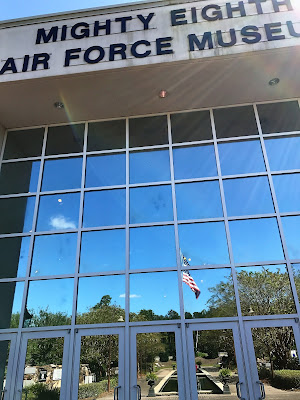 |
The museum is on 13 acres.
|
I've been to many air and space museums, but one of the best ever has to be the National Museum of the Mighty Eighth Air Force in Savannah, which lives up to its claim as "One of the world's most powerful museum experiences." It has over 90,000 square feet of aircraft, interactive displays, videos, artifacts and aviation art. A docent spent time with me explaining the significance of some items that I otherwise wouldn't have known. I learned so much about air power during WWII from this museum, which features a fully-restored B-17 Flying Fortress as well as a collection of artifacts from various WWII 8th Air Force groups including personal items. A replica of a "safe house" and a POW exhibit were also fascinating. The memorial gardens outside were particularly moving to me. And the gift shop cashier was one of the most pleasant I've ever encountered. She shared some trivia with me that was fascinating.
Beautiful
Mary flew down from Dayton to spend a weekend with me. We has a great
 |
| The garden was designed by Frederick L. Olmstead. |
dinner at the Council Oak Steakhouse and Mary did a little gambling. We also had lunch at the original Columbia restaurant in Ybor City, which is where we always took out-of-state visitors when we lived in Tampa. And we drove out to the Bok Tower Gardens, which is something we had always wanted to do but never got a chance to when we lived in Florida.
The centerpiece of the 50- acre garden is a 205-foot marble and coquina Singing Tower that was dedicated in 1929 by President Coolidge. The carillon has 60 bronze bells, with the largest weighing 11+ tons. There are daily concerts!
The garden and tower are on the grounds of the Pinewood Estate, the winter estate of American industrialist Charles Austin Buck from 1932 until his death in 1945.
Mary and I enjoyed a tour of the home, walking through the gardens, listening to the carillon, and lunching in the cafe.
After two weeks as FEMA's lead PIO in Savannah, Georgia, I was transferred to Ft. Myers, Florida. I had plenty of time to adjust, because I drove my rental car from Savannah to Ft. Myers.
 |
| Hurricane Irma was a Cat-3 storm when it slammed into Florida. |
 |
| Federal teams and voluntary agencies worked to help those in need. |
 |
| Teams staffed emergency shelters, provided meals, and offered comfort. |
 |
| FEMA transferred 2.4 million meals and 1.4 million liters of water to Florida. |
Here's what I did in Florida:
Media
FEMA: Apply for
disaster grants
Michael D.
Bates
Oct 17,
2017
Barring any
last-minute extension, the last day for Hurricane Irma victims to apply for
disaster assistance from the Federal Emergency Management Agency (FEMA) is
Thursday, Nov. 9.
Already, about
13,250 Citrus Countians have applied for a FEMA grant. And FEMA spokesman Steven Solomon
said Tuesday the agency does not want to leave anyone out of the loop.
“The sooner you
start the process, the sooner the application can be processed,” said Solomon,
who visited with the Chronicle on Tuesday.
But the
watchword, he said, is patience. This summer, the nation has been hit hard by
three devastating hurricanes: Irma, Harvey and Maria. The fires in California
have further added to the equation and resulted in a backlog of FEMA
applications. It may mean longer-than-normal waits for agency inspectors to
come out to the person’s home.
People can
apply for such things as low-interest loans for a variety of reasons:
rebuilding homes destroyed by fallen trees, flooded homes along the
Withlacoochee River, reimbursement for hotel stays during an evacuation and
food spoiled in a power outage.
Statewide, more
than 2.48 million Floridians - homeowners, renters - have registered with FEMA
for federal assistance. Citrus County was among 48 Florida counties designated
for eligibility.
Solomon said
FEMA does not give federal grants to owners of businesses that have been
damaged but will for their personal, primary residence. They would have
recourse to the U.S. Small Business Association (SBA) for their business
establishments.
Solomon urged
people to beware of scammers, posing as FEMA officials and asking for money or
claiming they can process the paperwork fast. FEMA, he said, does not ask for
fees.
And don’t be
too stoic to apply for a FEMA grant, he said.
“Some folks
feel they are in a position to handle this on their own and that if they apply
and get a grant, they are leaving less money for those less fortunate than
them,” Solomon said. “That’s not the case.”
And Solomon
said he wants to dispel the notion that people who apply to FEMA for monetary
reimbursement or help are agreeing to a loan.
“This is not a
loan,” he said. “It’s a grant.”
If people are
sitting at home with a gaping hole in their roof or other home damage from Irma
that is creating an unsafe or unhygienic condition, get it repaired now and
don’t wait for a FEMA inspector, Solomon said.
Just be sure to
take photos of the damage and keep repair receipts.
Solomon said
FEMA disaster assistance does not affect people’s Social Security or other
federal benefits and is not considered taxable income by the IRS.
HOW TO CONTACT
FEMA:
Individuals and
business owners who sustained losses can begin applying for assistance today by
registering online at disasterassistance.gov,
or by calling 800-621-FEMA (3362). The toll-free numbers will operate from 7
a.m. to 10 p.m. seven days a week.
 FEMA assistance
deadline looming
FEMA assistance
deadline looming
The deadline to
apply for FEMA assistance in Florida is Nov. 9 and more than 2.48 million
Floridians have already contacted the group about aid. In Hillsborough County
alone there have been 123,500 registrations, according to Steven Solomon, a media relations
specialist for FEMA.
There are
several ways to register for assistance if you live in a designated disaster
relief county. You can apply online at disasterassistance.gov, call the
helpline at 800-621-3362, use the app or go in person to a disaster recovery
center. The centers will be a “one stop shop,” Solomon said. There will be
representation from both the state and county as well as the Small Business
Administration, which offers low-interest loans.
There are also
more than 650 Disaster Survivor Assistance team members going door to door in
affected neighborhoods statewide. Solomon said to make sure the person at your
door has a federal ID badge and to call the helpline if you have questions. He
also said FEMA has no fees for any of its services.
To register for
aid you do not need physical documents, just the information on them. You will
need your Social Security number and the name on that card, the address of the
damaged property and a phone number and contact address. If you have insurance
you will need your total household income and a bank account routing number.
After
registering an inspector will come assess the property. FEMA will then
determine if you are eligible for help.

Federal aid
available for Hurricane Irma victims
By Kathy
Steele
October 18,
2017
Federal
emergency management teams are fanning out statewide to help Hurricane Irma
victims register for financial assistance.
Residents in
Pasco County lost trees, and in many instances, suffered damage to their homes
due to Hurricane Irma. The Federal Emergency Management Agency is taking
applications to provide financial assistance. (Kathy Steele)
In Pasco
County, a team settled in at the Land O’ Lakes Branch Library on Collier
Parkway from Oct. 11 through Oct. 14.
Area residents
applying for assistance also could speak with representatives of the United
States Small Business Administration and Pasco County.
Pasco County
officials will make announcements soon about more locations that will open to
take applications.
The in-person
meet-ups with Federal Emergency Management Agency workers are only one of
several ways to register for financial assistance.
Currently, the
deadline to register is Nov. 9.
State officials
have the option to request an extension, however.
Steven Solomon, a FEMA media relations specialist, said the easiest way to apply is to
online.
The website is
Disasterassistance.gov.
For those who
don’t have access to a computer or the Internet, they can call FEMA at 1-800-621-3362. Because FEMA is
responding to a number of recent disasters, including Irma and Hurricane
Harvey, there could be long waits on the phone.
“We’re asking
for people to be patient,” Solomon said.
FEMA workers
also are out in the field in the 48 counties declared as federal disaster
areas. “We’re walking door-to-door with Ipads, registering people as we go,”
Solomon said.
The field
workers will have a federal ID badge, which residents should ask to see,
Solomon said.
Those who
register with FEMA for assistance will be asked to provide the following
information:
§ Social
Security number
§ Address
of the damaged property and a contact phone number
§ Insurance
coverage
§ Total
household income
§ Bank
routing number and account number
FEMA will
schedule an appointment for an inspector to meet the applicant – age 18 or
older – at the hurricane damaged property. The inspector doesn’t determine
eligibility, Solomon said.
All of the
information is sent to FEMA, and a letter will be sent to the applicant
regarding a grant award.
FEMA grants can
pay for a variety of losses including home repairs, temporary housing,
transportation, medical and dental costs and funeral expenses.
These will be
grants, not loans that would be repaid. Also, grants are not considered taxable
income, and they don’t affect other benefits being received, such as Social
Security or food stamps.
Homeowners with
property insurance should file separate claims with their insurance companies
and FEMA. The federal agency can supplement what insurance doesn’t cover.
Grant amounts
aren’t intended to be a dollar for dollar replacement of all losses, but
Solomon said they can aid in “making people whole again.”
Businesses can
apply for low-interest loans through the Small Business Administration. Solomon
said it also would be helpful for business owners to talk with FEMA
representatives to find out if other types of benefits also would be available.
Anyone who
needs repairs completed should do so as quickly as possible, without waiting
for a FEMA decision, Solomon said. But, they also should take pictures of the
damage and keep receipts for purchases and services, he added.
Everyone should
be on the alert for scam artists trying to take advantage of people, Solomon
said.
“There is no
charge for anything FEMA does,” Solomon said. “If (anyone) asks for money, it’s
a scam.”

Tampa couple becomes FEMA fraud victim
By Sara
Belsole, Reporter
Last Updated: Monday, October 16, 2017, 6:22 PM EDT
TAMPA -- Jack
and Pam Kilbride are one of the lucky ones.
Their Tampa
home didn't sustain any damage from Hurricane Irma.
Tampa husband,
wife get FEMA check despite no damage
FEMA spokesman:
$700 million handed out in Florida after Irma
Think you're a
victim? Check out info below
But the
Kilbride's got a letter in the mail from the Federal Emergency Management
Agency saying they filled out an application for disaster relief funds.
"It had
the last four digits of my social security number, my phone number, my
name," Jack Kilbride said. "We pretty much figured out we were the
victim of fraud."
The Kilbride's
then got a $500 check in the mail from the government, and a FEMA contractor
left a note on their door saying she had visited the property.
FEMA spokesman Steven Solomon said to date the agency has handed out
more than $700 million to Floridians in need of help after Irma. He said this
opens the door for potential criminal activity.
"Anyone
who thinks they may have been a victim of fraud should first contact their
local law enforcement agency and should follow up with FEMA," Solomon
said. "Give us a call at the helpline, or if you prefer face-to-face, step
into a recovery center."
The Kilbride's
have contacted FEMA and local law enforcement and still don't have any answers.
They said they are left with an unsettling feeling that someone out there has
their personal information.
"It's very
sad and I don't know how far reaching it is, but people taking advantage of bad
times is just unbelievable," Kilbride said.
If you think
you are a victim of fraud, you can email FEMA-OCSO-Tipline@fema.dhs.gov or STOPFEMAFraud@fema.dhs.gov.
You can also call (866) 223-0814, send a fax to (202) 212-4926 or write to the
FEMA Fraud and Internal Division, C St. SW Mail Stop 3005, Washington D.C.
20472-3005.
Recovery
efforts continue one month after Irma
Justin Martin October 11, 2017
On September 10,
Hurricane Irma made landfall bringing an unprecedented amount of damage across
the state. While life has returned to normal for many in Southwest Florida,
local and federal agencies are still working to help those hardest hit and deal
with the wreckage from the storm.
FEMA has been heavily
involved in the recovery ever since Irma hit, opening a Disaster Recovery
Center in Bonita Springs and deploying 44 Disaster Survivor Assistance Teams
across Lee and Collier Counties. According to Steven Solomon, a FEMA spokesperson, the federal
agency has fielded more than 2.38 million requests for assistance or
information about recovery programs from across the state and 182,400 people
have registered for aid in Southwest Florida alone.
Around $713 million
has been approved for Florida residence through FEMA’s individual assistance
program, which helps claimants deal with a myriad of different personal damages
or losses from the storm. Flooding, the major source of damage in places like
Bonita Springs and Everglades City, has triggered 24,000 flood-insurance claims
through the Florida and National Flood Insurance Program and has resulted in
$62 million in payments.
Not everyone who
applies has their request approved, but all cases are subject to an appeals
process. Solomon said that in many cases requests are declined due to simple
mistakes on the application that can easily be fixed.
“Most of the time a
determination letter goes out, if there was a problem, often it’s because there
is a missing signature or just a piece of information,” Solomon said.
After a storm hits,
the first recovery effort people look to is often getting the lights back on.
Florida Power and Light underwent a mammoth effort after Irma, restoring power
to over 4.4 million customers statewide. At one point, more than 28,000 workers
labored to clear downed trees and repair lines until the company announced it
had completed restoration work on September 22. FPL spokesperson Chris McGrath
said that post-restoration, the company’s top priority is evaluating the performance
of the power grid during and after the storm.
“The big thing for us
right now is doing what we consider a pretty detailed forensic analysis of our
system to get a sense of just how exactly it performed and figure out how we
can get even better in storm response,” said McGrath.
McGrath said early
results point to the $3 billion that FPL has spent on improving its grid paying
off. After Hurricane Wilma in 2005, the company invested heavily in
strengthening transmission structures which shaved days off the recovery time
for Irma.
FPL has identified two
areas in which it needs to improve according to McGrath, communication with
customers and educating residents on tree planting. Trees and other plant life
blowing into powerlines was the number one cause of outages during Irma. While
workers can reinforce the pole, lines will always be vulnerable. FPL plans on
stepping up its efforts to educate both individuals and local governments on
proper tree placement to avoid damaging power lines during a storm.
While not the first
thing people think about after a storm, debris removal is a time-consuming and
costly part of hurricane recovery. Estimates are placing the amount of plant
debris left by Irma at about three million cubic yards in Lee County alone,
more than three times the debris from Hurricane Charley. County staff said that
the cost of cleanup will be between $55 and $60 million and could take more
than five months. Currently, a website Lee County set up to track its progress
shows the process as 25 percent complete. Despite commissioners objecting to
the long recovery time, the county is in a bind. The wide impact of Irma means
that waste removal contractors are in heavy demand and commanding a premium.
County Manager Roger Desjarlais even went so far as to characterize contractors
as “profiteers.”
Even if local
governments can secure extra help to expedite the process, they risk
endangering their reimbursement for debris removal from FEMA, which requires
competitive contracts to be in place pre-storm. That could leave taxpayers
footing the bill for tens of millions in recovery costs.
American Hero
 |
| I have an Edison phonograph and cylinders at home. |
Mary and I had been there before, but it was quite awhile ago, so on my first day off I visited Thomas Edison's winter estate in Ft. Myers. And although they were still cleaning up after the storm, and the house wasn't reopened yet, I was able to go on a tour of the museum, lab and gardens. The landscape today is still dominated by the huge Ficus trees planted by Edison, Henry Ford and Harvey Firestone during the time of their quest to find a viable domestic source of rubber (latex) to grow in the region. It also includes varieties of palms, citrus, bamboo and orchids. The Heritage Garden represents the original truck garden of fruits and vegetables used by the families for food. Today, the Edison Ford is home to more than 1,700 plants, including champion trees and continues Edison's tradition of an ever-changing botanical laboratory and garden.





